COMPUTE/COMPETE #1
AI Squid Game & The Most Competitive Economy

Author’s Note:
When I first decided to pause, at the time indefinitely, my series This Week in the World, I did not think I would be returning to writing a newsletter.
I had found myself compelled to put out a post every Sunday (normally frantically written on the Saturday before). Yet, at the same time, I was frustrated by the lack of effort I devoted to it. I was stuck in a loop of dissatisfaction, unsure of why I continued to write the series in the first place. My content felt, in some ways, aimless.
And so, mulling it over during the holidays, I resolved to return to writing long-form articles. One topic, with purpose and a commitment of effort. I even attended a talk where the great Jordan Schneider jokingly asserted that writing about only one thing for the span of three months would make you that thing’s subject matter expert. (He gave the example of Chinese thermal power. Don’t worry, I won’t write about that).
Yet, as I considered what topic I would focus on, a realization came to me: Substack is meaningless. No offense to you reading this, but, here, there’s nothing really on the line. It’s not a school assignment. It’s not a journal article. I can kind of do whatever I want—whatever format, whatever style.
So here I am back to writing a newsletter, but this time I won’t give myself a time limit and I’ve chosen a better name.
COMPUTE/COMPETE will chronicle the story of Geopolitical AI, a term I made up to embody the growing geopolitical implications of the entire AI stack. Critical minerals and the electrostate that consumes them, data centers and the semiconductors that run them, not to mention the all-venerated models and the companies that harness them.
Foretold by the great prophet Sam Altman to be heralds of an economic and societal and political and military and scientific—you get the gist—revolution, Artificial Intelligence is being theorized, pursued, developed, and deployed all around the world. Yet, we often only hear about a few narratives: the US (AI BUBBLE) and China (ROBOTS EVERYWHERE). What about the Rest of World?
Here, I’ll try to tell the story of AI globally—from the scramble to obtain the resource proclaimed king (compute) to today’s great, mad zeitgeist that enthralls kings (compete). Some people say: “If you own AGI (Machine God), you’ll own the future.” So, let’s see what people will do to own Machine God.
Enjoy!
P.S. COMPUTE/COMPETE is a project in collaboration with European Guanxi. You can also find the series on their Substack!
HOW TO MAKE SOVEREIGN AI? SOME SAY: SQUID GAME

Every country is pursuing the development of national AI models their own way. How does South Korea, a nation infamous for its extremely competitive education and corporate ecosystem, plan on pursuing it? You guessed it right—a tournament arc.
Sorry, a tournament arc?
Yes! A tournament arc!
You see, it all started following the botched attempt by then-President Yoon Suk Yeol to impose martial law and hijack the government. Having seen this show before, South Koreans flocked to protest, eventually leading to the impeachment of the then-President and later installment of now-President Lee Jae-myung.
Now, President Lee is taking this whole “Sovereign AI” idea seriously. He not only appointed the former AI chief of Korean tech giant Naver Ha Jung-woo as the first ever presidential Chief AI Officer, but also nominated LG’s AI lead Bae Kyung-hoon as the new Minister of Science and ICT. (Note: Both of them are 40-something industry experts, extremely young blood in an administrative scene known for career politicians and senior academics).
What do you mean Sovereign AI?
At the bare minimum, the administration argues that foreign firms shouldn’t control the critical infrastructure around areas like diplomacy and defense—especially due to an infamous case of ChatGPT referring to the “East Sea” as the “Sea of Japan,” a highly sensitive issue in South Korea. Beyond that, AI models encode a nation’s culture and norms. Not having a domestically made model, then, risks ceding cultural agency to foreign developers—what data is fed into it and what outputs are permitted. (For example, Beijing is keen to make sure all Chinese models embody “core socialist values”).
At the maximum, however, Chief AI Officer Ha believes AI will be the primary tool of 21st century neo-imperialism: “Just as past empires used guns and ships to colonize territories, he argues, future powers will use AI to dominate the digital territories and data of other nations, subordinating their industrial ecosystems.” Quite the big jump, isn’t it?
While popular reaction first considered his remarks as guk-ppong (국뽕), a slang term for jingoistic fervor, due to his coincidental background at Naver, sentiment quickly pivoted following the infamous DeepSeek Moment, when a Chinese quant firm proved frontier AI could be pursued outside of capital-rich America.
And so, the government announced the Independent AI Foundation Model project with the intention of manufacturing a national AI champion through what South Korea does best: cutthroat competition. 5 AI labs, a single org eliminated every 6 months, until just 1 remains. Lose, and you forfeit access to government-provided GPUs and data sets. Win, and you become the national open source model—a position of infinite pride, honor, and, of course, reward. It’s so exciting one could even be forgiven for stereotypically labelling it as the “AI Squid Game.”
“To be involved in a project this important is a rare honor… It’s an engineer’s dream,” one team lead said. “This is nerve-racking. But this is exactly how K-pop took off,” another.
Okay, I’m hooked. How’s it going?
Well, some were initially hesitant, fearing the potential creation of a new chaebol. Chaebols, large conglomerates typically owned by a single family, are infamous in South Korea due to their extreme economic and political influence. Some examples include Samsung, Hyundai, SK Group, and LG Group—have you heard of them? They collectively account for over 50% of South Korea’s market cap.
So, with two former top executives from the nation’s two largest tech companies at the helm of national AI policy and a government-ordained market leader as the explicit goal of the competition, some startup founders were understandably concerned: “it will create a very strange structure where foreign AI giants, domestic MSPs, and countless B2B software partners will have to band together to compete against the government’s AI.” These startups, chasing vertical, specialist, and splintered AI, see a potential future where one firm boxes out the rest.
Yet, beyond that trifling concern, the tournament has been nothing but exciting.
Livestreamed to tens of thousands of viewers, Naver’s team has already been eliminated for using foreign (Chinese) technology. You see, the government has decreed that to build a national model one must use national tools: proprietary learning processes, data and architecture—all built from scratch. This is particularly notable as borrowing and inspiration are extremely common occurrences in the AI ecosystem, especially when startup labs face prohibitive budgets. Despite claims of technological independence on both sides, it is well known that many Chinese models first built off of Meta’s open-source Llama.
We likely won’t have a winner until 2027, but only time will tell whether the true purpose of this competition is to incubate a frontier model or just to build momentum and energy within the South Korean AI ecosystem.
Meanwhile, the government also recently enacted some of the world’s first AI safety regulations, requiring human oversight in cases of "high-impact"AI application (nuclear safety, drinking water, etc) and the clear labelling of AI-generated output. Though the measures were much to the dismay of South Korea’s tech leaders—with one bemoaning “why do we have to be the first to do this?”, only time will also tell whether the country can prove AI excellence and AI safety can go hand in hand. (American AI companies say it can—that is, if only the Chinese weren’t forcing their hand. They must “save the free world,” and all that good stuff).
Nonetheless, Sovereign AI is high on the new President’s mind for the country’s future. “A national infrastructure of compute power, data and the rollout of 6G technology… By invoking the same logic that built the roads and the web, Korea is betting that it can once again engineer its way to the top.”
CHINA’S AI COLOSSEUM IS A GIFT FOR THE WORLD
What do Chinese AI startup Z.ai turning its attention to Global South markets, AI agent startup Manus selling its technology to Meta, and TikTok’s creator ByteDance announcing a data center project in Brazil all have in common? You guessed it right: China’s attempts to dominate the world through technological supremacy.
Just kidding.
While it has become all-too-common and all-too-easy to frame the Chinese tech ecosystem through the lens of a one dimensional US-China “AI Race” narrative (Substacker Kevin Xu helpfully counters with the phrase “co-opetition” to point out the many interconnects), these trends instead point to one increasingly pervasive truth: Chinese AI startups may be increasingly forced to look for revenue in foreign markets just to survive. A smaller financial market, overly saturated domestic competition, and, most importantly, endemically weak consumer spending have left very limited room for success at home.
Wait, you’re telling me Chinese companies are going abroad just to survive? What about all the hubbub about Chinese technological excellence?
Well, both stories can be true at the same time.
First, take the case of Manus. Manus, a subsidiary of the company Butterfly Effect, gained international renown last March for releasing one of the first AI Agents capable of true agency, building custom websites and writing detailed research reports. What was particularly impressive was the fact that it accomplished this feat despite not being a traditional AI lab—it instead built on top of Alibaba and Anthropic’s models. More than that, however, it built the technology using very little initial funding compared to other startups, and was in the green just 8 months after it launched, reaching $100 million in annual revenue (imagine that, OpenAI). The only caveat: a lot of its customers were American.
You see, Manus was running into the age old problem in China: structurally low consumption spending. Having successfully climbed the manufacturing value chain out of poverty, Beijing has been cautious about giving up such a driver of economic growth, with local governments continuing to subsidize initiatives like factories despite many international economists arguing for consumption as the path to a sustainable market. The many, often locally driven industrial subsidies have played a large part in China’s technological rise, aiding the development of cutting-edge sectors from batteries to EVs and now robots. Yet, the lack of spending on a social safety net has led to a high domestic preference for saving, and the strategy of every province having its own industry champion has led to every capitalist’s nightmare—price-spiraling involution.
To escape this hyper-competitive environment, Manus moved its office to Singapore and was eventually bought up by Meta. (Here, in America, we prefer consolidation to competition). Small-but-mighty AI lab Z.ai may be deciding to do something similar.
With the Chinese AI ecosystem featuring the tech giants of Alibaba, Tencent, and Baidu in a moshpit against the startups of Moonshot, MiniMax, Z.ai, and, of course, DeepSeek—and those are just the ones achieving prominence, the already tight consumer market is, lets say, cozy. And so, what does a frontier lab desperately seeking revenue do? According to Z.ai’s head of global partnerships: look elsewhere.
Having been one of the first AI companies to IPO, Z.ai sees opportunity in other countries’ desires to achieve Sovereign AI. Where governments or companies want on-premise deployment in order to maintain data control or where foreign AI firms seeking to publish “national AI models” wish to save money by fine-tuning and building off of already impressive technology, Z.ai claims it has the capability, cost-effectiveness, and, most importantly, humility to take that auxiliary role.
At least, it’s better than the ongoing battle-to-the-death in China. Where foreign analysts see global expansion as competition, Chinese firms see it as simple business necessity.
Ok, so Chinese startups are turning domestic challenges into opportunities. What about ByteDance’s Brazilian data center project? ByteDance isn’t a small startup.
You’re exactly right, the case of ByteDance’s new data center project tells the flip-side of the story. While extreme domestic competition is pushing some startups to flee abroad, ample opportunity is attracting other Chinese companies to underserved parts of the world. Latin America is perhaps the best example of this trend.
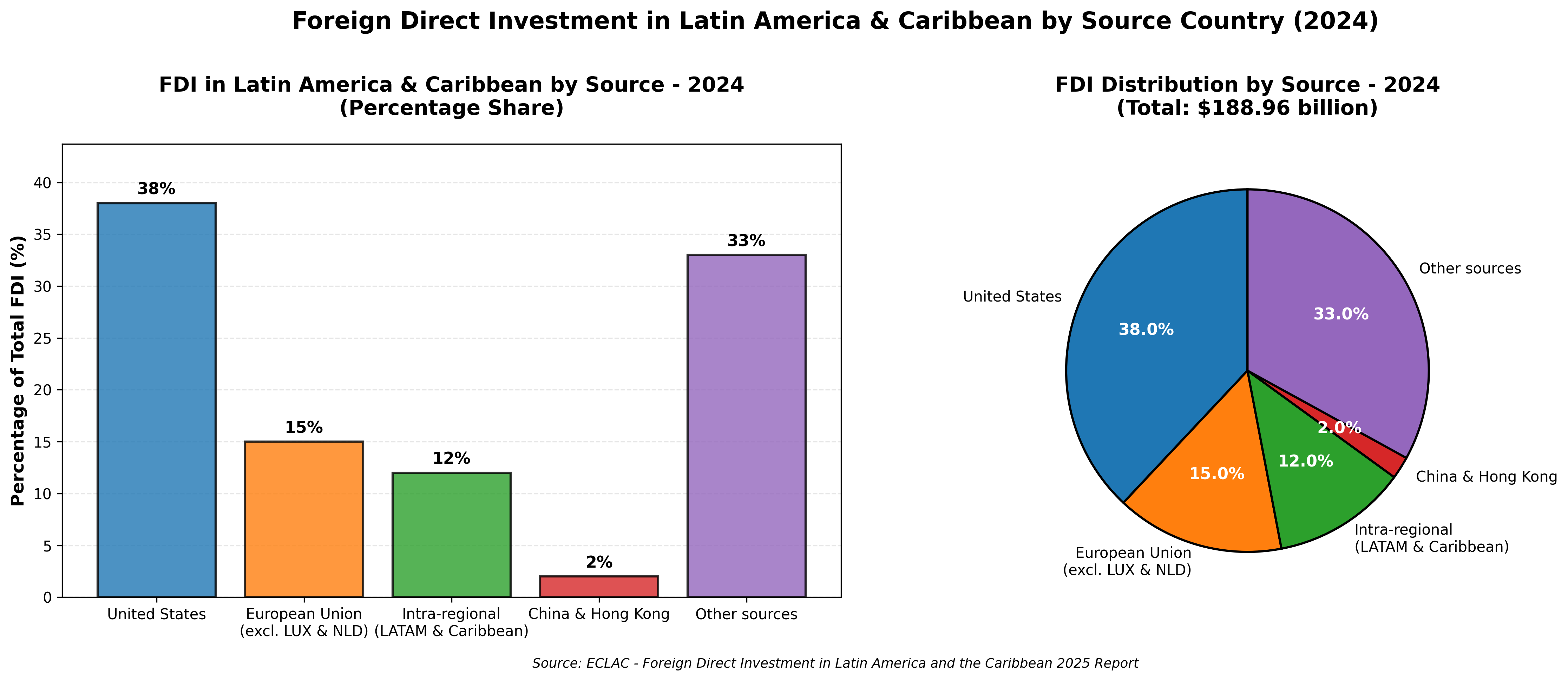
As you can see from the chart above, the US is by far the largest single source of Foreign Direct Investment (FDI) into the region. Yet, the investment is largely focused on business operation expansion, either through supply chain nearshoring or increasing local services (such as GE expanding a local subsidiary). This leaves a sizable gap for more capital heavy investments in infrastructure projects and resource extraction—vitally needed spending that is dominated by Chinese firms yet doesn’t appear in FDI calculations.
While traditionally these projects have taken the form of ports, roads, dams, etc, there’s a hot new infrastructure project on the mind and budget of almost every state: data centers. Previously used to store the data and run the operations of digital services, data centers have taken on a supercharged importance as their GPUs (Graphics Processing Units, or what Nvidia sells) have been used to train and run ever-more-powerful AI models. As geopolitics has grown increasingly ruptured, countries have only increasingly seen the need to ensure domestic data storage capacity and domestic AI inference capabilities. They have, I would argue, become critical infrastructure reminiscent of the industrial bases, or lack thereof, which created traditional extractive economies. And, they are currently extremely concentrated in the hands of a few companies and states.
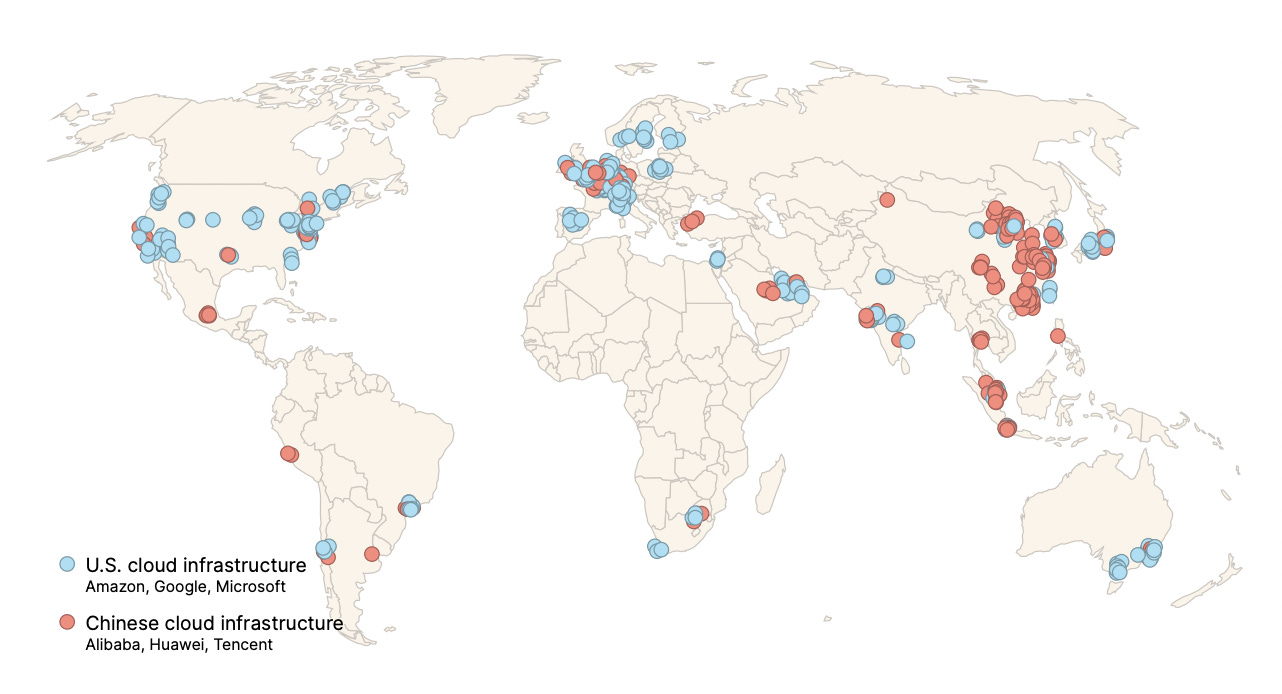
Here in the story enters ByteDance’s Brazilian data center project. The company is planning on building a data center with the initial capacity of 300 megawatts and eventual capacity of up to 1 gigawatt—equal to the size of the Stargate project in the UAE. Primarily for storing regional data, the facility will supposedly also be capable of powering “high-density AI computing.”
The project not only marks an explosion of compute power for Brazil, though the facility will be exclusively owned by ByteDance, but, even more importantly, it validates Brazil’s strategy to become a regional digital powerhouse. The construction, in partnership with renewable energy giant Casa dos Ventos and Patria’s data center developer Omnia, will be 100% renewably powered, furthering the development and applicability of Pecém’s wind energy park for future data center projects.
Beyond increasing Brazil’s viability as a data center hub, the project plays another role in the country’s AI ambitions. As the head of the local Special Economic Zone says, “‘Data centers are not the end goal — they’re the bait to attract high-tech industries and Big Tech operations,’ Feijo said in an interview, describing the vision as ‘Ceará Valley.’”
Fascinating… does this connect to South Korea’s strategy at all?
Absolutely! Brazil, South Korea, China—all countries are seeing the rise of Artificial Intelligence as not only a once-in-a-lifetime chance to climb the global value chain and secure much-needed investment, but also as a vital make-or-break moment with ramifications in everything from cultural determinism to national security. And, that’s not even to consider what would happen if someone really does awaken Machine God.
That being said, Sovereign AI is expensive. So, the question is: how can countries align its pursuit with economic realities? We’ll see the answer in the years to come, in which countries make it out of this transitionary phase on top.
Keep up with it here, on COMPUTE/COMPETE.